

From Gargoyles to Gutters: The 900-Year History of Keeping Water Off Your Walls
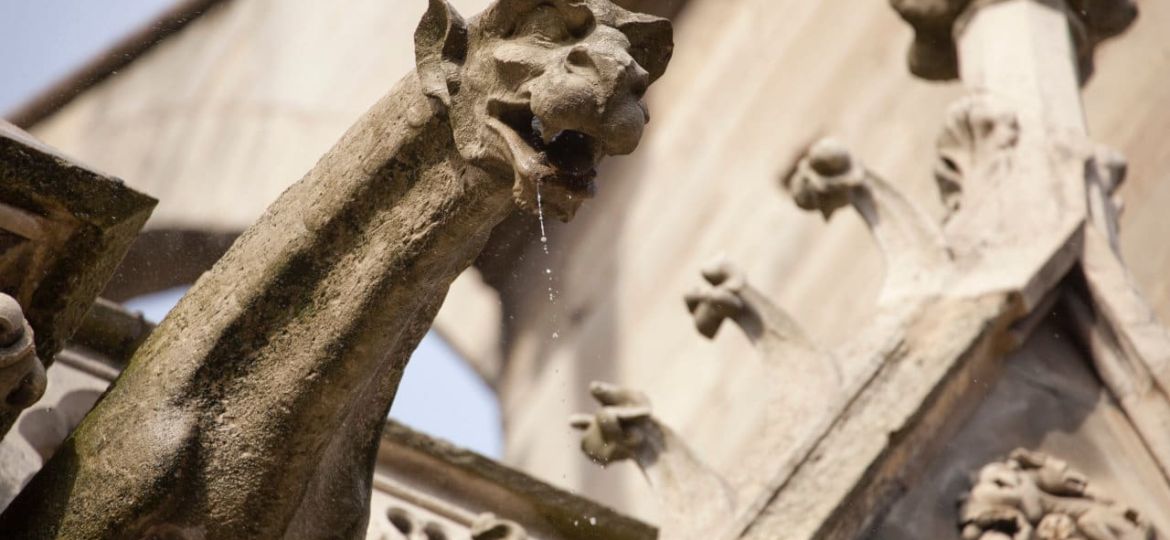
When you look up at a medieval cathedral and see a grotesque stone creature jutting out from the roofline with water streaming from its open mouth, you’re looking at one of history’s most ingenious — and most dramatic — gutter systems ever devised. The gargoyle wasn’t born from superstition alone. It was born from the same problem that brings homeowners in Asheville to the phone with us today: water that has absolutely no business running down the side of a building.
What Is a Gargoyle, Really?
The word “gargoyle” comes from the Old French gargouille, meaning “throat” — and that etymology tells you everything. A true gargoyle is a carved stone waterspout, typically protruding several feet from a parapet or roof edge, designed to channel rainwater away from the walls and foundation of a structure below. The hollow throat or pipe running through the sculpture carried water from the roof’s drainage channel and shot it outward, landing safely in the street or courtyard rather than cascading down the face of the building.
That distinction matters. Not every creepy carved figure on a cathedral is a gargoyle. A figure that sits decoratively without a drainage function is technically a grotesque. Only the ones doing the actual water management work earn the name gargoyle. Medieval builders understood function and form well enough to combine them — and they were clever enough to make the function look like a monster.
Gargoyes At Biltmore House, Asheville NC

The Problem They Were Solving
By the 12th and 13th centuries, European cathedral builders faced a serious engineering challenge. Gothic architecture had moved away from the thick, load-bearing walls of Romanesque buildings and toward towering stone structures with large windows, thin walls, and flying buttresses. These buildings were masterworks — and they were also incredibly vulnerable to water damage.
Without proper water management, rain running down the face of the stone would erode mortar joints, stain the facade, seep into cracks, freeze in winter, expand, and gradually destroy centuries of craftsmanship. The solution was to get the water off the roof and away from the walls as aggressively as possible. Lead-lined stone channels called gutters ran along the base of the roof, collecting rain from the entire surface area. Those channels needed somewhere to discharge, and discharging them directly at the wall was exactly what they were trying to avoid.
Enter the gargoyle. By running the drainage channel through a long stone figure angled slightly downward, builders could project the water stream two, three, sometimes four feet out from the wall. The longer the snout or neck of the creature, the further the arc of water traveled. It was physics in service of preservation — and the medieval craftsmen who carved them clearly had fun with the assignment.

Notre-Dame, Chartres, and the Golden Age of Stone Gutters
The Cathedral of Notre-Dame de Paris, construction of which began in 1163, is perhaps the most famous example of gargoyle drainage in the world. Its iconic stone figures — chimeras, demons, winged beasts — became so associated with the building that they define the popular image of Gothic architecture to this day. But it’s worth noting that many of Notre-Dame’s most recognizable figures were added or heavily restored by architect Eugène Viollet-le-Duc during a major 19th-century restoration. The originals had worn, broken, or fallen over the centuries. This speaks to a practical truth: stone gargoyles, however durable, had a lifespan. They were maintenance items. They broke, they cracked, and when they failed to channel water properly, the buildings they were meant to protect suffered.
Chartres Cathedral, the great churches of Cologne and Strasbourg, the cathedrals of England’s Wells and Lincoln — all deployed gargoyle systems as an integral part of their water management. Some churches had dozens of them arranged at regular intervals, each responsible for a section of the roofline, operating together as a distributed drainage system. The redundancy was intentional. If one failed, the others carried the load.
The Mythology That Grew Up Around Them
Medieval builders were practical people, but they were also deeply religious, and they understood the power of a story. The gargoyle’s frightening appearance served a dual narrative purpose: it was said to ward off evil spirits, protecting the holy ground below. In church iconography, the demons were being made to serve God — forced to labor as waterspouts, doing useful work rather than causing mischief.
This gave the gargoyle a kind of cultural permanence that a plain lead drainpipe never could have achieved. People told stories about them. They gave them names. They developed folklore. And so the gargoyle became not just a functional drainage solution but an architectural symbol, a piece of visual storytelling built into the very bones of the building.
There’s something to be said for that. Good design solves problems and means something. The best-built homes in Asheville — historic cottages, craftsman bungalows, mountain modern builds — all have a relationship between form and function that echoes, in a modest way, what those medieval stonemasons were up to.
Lead Pipes, Downspouts, and the Long Road to Modern Gutters
As building technology evolved through the Renaissance and into the 17th and 18th centuries, stone gargoyles gradually gave way to more efficient (if less dramatic) water management systems. Lead pipes and wooden troughs were used in Tudor and Elizabethan England to route water from the roof to the ground. Cast iron gutters emerged in the Industrial Revolution, allowing for standardized, mass-produced components that could be installed faster and maintained more easily than carved stone.
By the late 19th and early 20th centuries, pressed steel and galvanized iron had become common materials, and the familiar K-style aluminum gutter profile — the kind we install throughout Western North Carolina today — emerged in the mid-20th century as a dominant residential standard. Aluminum was lighter, rust-resistant, easy to form into seamless runs, and far cheaper than iron or copper. The modern era of rain gutters had arrived.
The gargoyle, in this sense, never truly disappeared. It just became a downspout.
What Gargoyles Can Teach Us About Gutters Today
Here’s what’s striking about the gargoyle tradition: it was built around an understanding that water is patient and relentless. The medieval builders who engineered those drainage systems understood that if you let water run down your walls even occasionally, it would find the cracks, widen them, and eventually win. Their solution — project it outward, keep it away from the structure — is the same principle behind every gutter installation we do at Gutter Madness AVL.
The mountains of Western North Carolina bring that lesson home every year. Asheville’s rainfall, heavy summer storms, and steep rooflines create exactly the kind of water management challenge that had those Gothic builders reaching for their chisels. Dense tree cover, heavy leaf fall, and seasonal debris mean gutters here work hard and need to be designed and maintained accordingly.
The materials have changed. The math has changed. But the principle — get the water off the roof, away from the walls, and safely to the ground — is 900 years old and just as valid on a craftsman bungalow in West Asheville as it was on the Cathedral of Notre-Dame.

The Modern Gargoyle on Your Home
Think of your gutters and downspouts as your home’s gargoyle system. They’re working continuously, in every storm, to protect your foundation, siding, fascia boards, and landscaping. When they fail — when they clog, sag, pull away from the fascia, or overflow — the same slow damage that crumbled medieval mortar starts happening to your home. Water backs up under shingles. It saturates soil against your foundation. It stains and rots wood it was never meant to touch.
The good news is that modern gutters, properly installed and maintained, are far more reliable than stone creatures. Seamless aluminum systems eliminate the joints where leaks start. Properly sized 5-inch and 6-inch profiles handle even Asheville’s heaviest downpours. Gutter guards reduce the maintenance burden in our heavily wooded neighborhoods. And a professional inspection after major weather events — like Hurricane Helene — can catch hidden damage before it becomes a costly problem.
At Gutter Madness AVL, we’ve been solving Western North Carolina’s water management challenges for over 30 years. We don’t carve stone monsters, but we do custom-fit drainage systems to every roofline, every slope, every overhang. The goal is the same as it’s always been: keep the water where it belongs.
Ready to protect your home the way the cathedral builders protected theirs?
Call Gutter Madness AVL at 828-215-2807 or request a free estimate online. We serve Asheville, Arden, Biltmore Forest, West Asheville, Fletcher, Candler, and all of Western North Carolina.
Gutter Madness AVL — 3873 Sweeten Creek Road Ste-B, Arden, NC 28704


